Participation in the Task Force on Nature-related Financial Disclosures (TNFD) Forum and registration for TNFD Adopter
We have joined the Taskforce on Nature-related Financial Disclosures (TNFD) Forum and registered as a TNFD Adopter in March 2025.
The TNFD Forum supports the discussions of the TNFD, an international organization established in June 2021 to develop a framework for corporate risk management and disclosure related to nature. The Forum is a stakeholder organization made up of companies, financial institutions, research institutions, and other organizations that have joined to support the development of the framework. In addition to our participation in the TNFD Forum, we have also registered with TNFD Adopter, a group of companies and organizations that have expressed their intention to disclose information in line with TNFD recommendations by FY2025.
In our management policy, we state that "As responsible members of society, we work together with society to contribute to solving various issues," and we are working to resolve social issues through our efforts to conserve biodiversity and the environment. We will actively disclose information about the impact of our group's activities on the natural environment and biodiversity, and we will contribute to the realization of a sustainable society by balancing corporate growth with the protection of biodiversity.
Our Group identifies nine social issues as priority topics ("materiality") based on their significance to stakeholders, as well as their potential impact on society and on our business operations. Similarly, in identifying nature-related issues (nature-related dependencies, impacts, risks, and opportunities), we assess our Group's dependencies and impacts on nature and determine key issues from the perspective of double materiality-namely, the magnitude of risks and opportunities for our Group, stakeholders, and the environment and society.
2. Scope of Disclosure
This disclosure covers the shipping and real estate businesses, including their upstream and downstream value chains. In the sensitive location analysis, we assessed and evaluated the marine areas navigated by the shipping business and the direct operational sites of the real estate business.
3. Locations with Nature-Related Issues
This disclosure presents the results of our Group's location based analysis for the marine areas traversed by our vessels and for the locations of our owned real estate assets.
4. Integration with Other Sustainability-Related Disclosures
Although this disclosure focuses specifically on nature related issues, we are considering integrating climate related information into future disclosures.
5. Time Horizons Considered
In identifying nature-related risks and opportunities, our Group evaluates impacts across the following time horizons:
Short term: 0-2 years
Medium term: 3-10 years
Long term: 11 years and beyond
6. Engagement with Indigenous Peoples, Local Communities, and Affected Stakeholders in Identifying and Assessing Nature-Related Issues
In conducting our business activities, our Group respects the human rights of all relevant stakeholders in accordance with international standards, as outlined in the IINO Group Human Rights Policy and our human rights management processes described in the "Governance" section.
The IINO Group regards efforts to address environmental issues as a key management challenge. We are examining initiatives and managing their progress across the entire Group. As an organization to discuss environmental issues, we have established the Safety and Environment Committee, which is chaired by the President and Representative Director and whose members include all executive directors and presidents of major group companies. Under the Risk Management Committee, which oversees company-wide risk-management activities, the Safety and Environment Committee is positioned as the committee responsible for formulating and promoting policies related to safety and the environment common to our company and all group companies. Meetings are convened regularly once a month. Moreover, the Safety and Environment Committee evaluates the environmental aspects of the Group's services and activities (including the aspects of biodiversity), with the Risk-Management Committee, Executive Committee, and Board of Directors monitoring and overseeing sustainability-related issues deemed important. The Representative Director also serves as the person responsible for nature-related issues within the Group.
Human Rights Policy and Engagement
As a global enterprise, the IINO Group recognizes that respecting the human rights of all people is our corporate social responsibility, signing the United Nations Global Compact to express our endorsement in September 2022. Moreover, as our highest-level policy on human rights based on our corporate philosophy, the IINO Group Human Rights Policy was formulated at a resolution passed by the Board of Directors on October 27, 2022. The Group will respect the human rights of all stakeholders involved in its business activities and fulfill its responsibility to respect human rights by addressing any direct or indirect adverse impacts on human rights that any of its business activities may cause.
In this disclosure, we present the results of the LEAP analyses conducted for our Group's two core businesses: shipping and real estate.
Shipping Business
Identifying Nature Dependencies and Impacts
To identify material nature-related issues, we assessed our dependencies and impacts on nature across both our direct operations and our upstream and downstream value chains. Each dependency and impact was evaluated for its level of materiality on a five-point scale ranging from "Very High" to "Very Low." After identifying the relevant sectors within our direct operations and value chain, we used ENCORE, a dependency- and impact-assessment tool to determine the level of importance. For direct operations, the assessment results were adjusted to better reflect the actual conditions within our Group.
【Major Dependencies in the Shipping Business】
We summarized the key ecosystem services relevant to the shipping sector in a heatmap. The assessment revealed that our value chain depends on various ecosystem services, including water purification, flood mitigation, flow regulation, and the restoration of solid waste.
【Major impacts of shipping Business】
The key impacts considered to be significant to the shipping business were compiled into a heat map. The assessment indicated that soil and water contamination, as well as environmental disturbance across the value chain, represent particularly significant impacts.
Identification of nature-related risks and opportunities
Based on the results of the assessment of dependencies and impacts, nature-related risks and opportunities in the shipping business were inventoried and organized. In addition to the dependency and impact heat map, external factors such as international policy trends were also taken into account in the inventory of risks and opportunities. Furthermore, items related to risks and opportunities were added based on the outcomes of analyses conducted in the current fiscal year.
【Risks and Opportunities in the Shipping Business】
Currently, important risks relevant to the shipping business include "more frequent and severe extreme weather events," "water shortages in canals owing to changes in rainfall patterns," "expansion of marine protected areas and stricter navigation rules in those areas," and "accidents during operation." Conversely, "developing and adopting ships with a lower environmental impact" and "implementing slow sailing" could be opportunities to contribute to sustainability. For an overview of the key risks and opportunities, please refer to "IINO Line TNFD Report, page 8."
Areas Requiring Attention in the Shipping Business
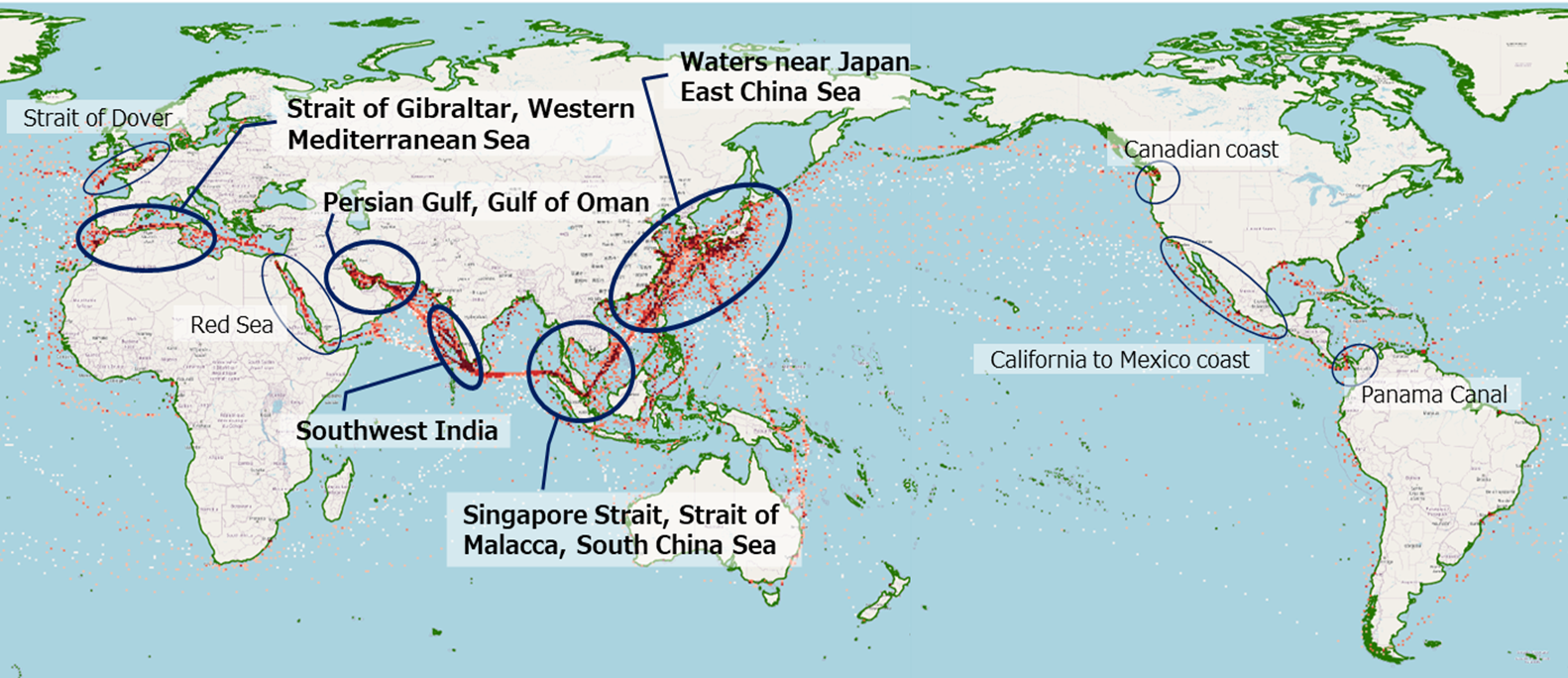
To understand the characteristics of areas requiring attention* and individual marine areas in the shipping business, analysis and evaluation of navigation areas were carried out based on position data from vessels directly operated by the company during 2023 to 2024. For details on the analytical methods and indicators used, please refer to "IINO Lines TNFD Report, page 10."
* Areas Requiring attention: Regions (marine areas) considered to be ecologically sensitive and susceptible to environmental impacts.
【Results of the analysis of areas requiring attention】
We identified caution areas as marine regions that are both ecologically sensitive and characterized by high traffic density of our Group-operated vessels. In coastal areas, we have identified seven regions as caution areas: the Persian Gulf, the Gulf of Oman, the Singapore Strait, the East China Sea, the vicinity of the Strait of Gibraltar, the coastal areas of the South China Sea, and the coastal zones of Japan (such as Sagami Bay and Tokyo Bay), and the southern coast of Korea and the coastal area of Incheon City.
In offshore areas, we have identified six regions as caution areas: the waters off Japan (Pacific offshore zone), the southwestern coast of India, the Strait of Malacca, the offshore area of the Gulf of Oman, the vicinity of the Strait of Gibraltar and the western Mediterranean, and the southern South China Sea.
Real Estate Business
Identifying Nature Dependencies and Impacts
We conducted our analysis and evaluation using the same process applied to the shipping business (p.21). Based on the results of this year's assessment, we reviewed and partially updated the evaluation disclosed last fiscal year.
【Major Dependencies in the Real Estate Business】
We compiled a heat map of the key ecosystem services considered important for the real estate business. The assessment revealed that our value chain depends on ecosystem services such as water purification, global climate regulation, and rainfall pattern regulation. It was also found that most of these dependencies are concentrated upstream in the value chain.
【Major Impacts in the Real Estate Business】
We compiled a heat map of the key impacts considered significant in the shipping business. The assessment found that, across the value chain, soil and water contamination caused by hazardous substances, as well as ecosystem disturbance, represent particularly significant impacts. Similar to our dependency assessment, it was also found that most of these impacts in the real estate business are concentrated upstream in the value chain.
Identification of Nature-related Risks and Opportunities
Based on our assessment of dependencies and impacts, we conducted a comprehensive review of nature related risks and opportunities relevant to the real estate business. In addition to the heat map illustrating dependencies and impacts, this review also incorporates external factors such as international policy developments. Furthermore, reflecting the results of the analysis conducted during the current fiscal year, we have added new items to our list of risks and opportunities.
【Risks and Opportunities in the Real Estate Business】
Risks in the real estate business that are considered important include "increased frequency and severity of storms and floods due to climate change," "strengthening regulations and ordinances regarding the withdrawal of water resources such as surface water and groundwater," and "water and soil contamination owing to improper management." Conversely, potential opportunities can be found in "reducing the environmental impact through more efficient use of construction materials such as water, wood, construction waste, and plastics" and "planning and operating real estate that uses low-impact, low-toxicity, resource-recycling materials." For details on the analytical methods and indicators used, please refer to "IINO Lines TNFD Report, page 13."
Areas Requiring Attention in Real Estate Business
As with the shipping business, a "locate" analysis was conducted in the real estate business for the purpose of identifying areas requiring attention. In the real estate business, analysis and evaluation were conducted for eight domestic properties owned by the company, using the TNFD recommended perspectives for areas requiring attention. For details on the analytical methods and indicators used, please refer to "IINO Lines TNFD Report, page 15."
【Results of the Analysis of Areas Requiring Attention】
Of the eight domestic properties owned by the company, seven were selected as areas requiring attention based on the results of biodiversity potential evaluation that included the perspectives of biodiversity importance, ecosystem integrity, and importance of ecosystem service provision among the criteria for areas requiring attention.
Risk and Impact Management
Process for Identifying and Assessing Nature-related Issues
Our Group identifies and evaluates nature-related issues in accordance with the LEAP approach developed by the TNFD. For this disclosure, we focused on the shipping and real estate businesses.
In identifying and assessing nature-related issues, we first conducted a qualitative review of dependencies and impacts on nature across both our direct operations and upstream/downstream value chains. For direct operations, we analyzed the natural interfaces and sensitive areas associated with the marine regions and ports our vessels navigate, as well as the locations of our real estate assets. Nature-related risks and opportunities were then identified by integrating the dependencies, impacts, natural interfaces, and sensitive areas identified to date, together with global developments such as regulatory trends in various countries.
Process for Managing Nature-related Issues
The nature-related issues identified are overseen primarily by the Safety and Environment Committee, chaired by the President and Representative Director and composed of all Executive Officers and the presidents of major Group companies.
In addition, the Sustainability Promotion Department and its cross-functional Environmental Promotion Working Team jointly develop plans and initiatives addressing environmental issues, including nature-related matters, and report regularly to the Safety and Environment Committee.
Integration of Nature-related Risks into Enterprise Risk Management
Nature-related risks identified as material to our business management are reported by the Risk Management Committee-responsible for Group-wide risk policies and oversight-to the Board of Directors. These risks are subsequently incorporated into the Company's enterprise risk management processes.
Metrics and Targets
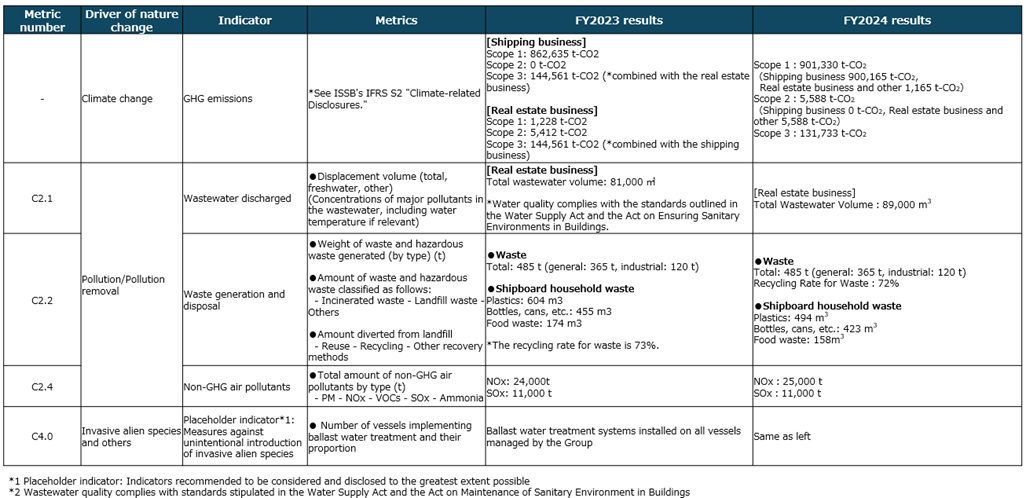
In this disclosure, we present the results for the indicators currently measured that correspond to the TNFD Global Core Metrics and the Shipping Sector Core Metrics. Going forward, based on the findings from the LEAP analysis conducted from last fiscal year through this fiscal year, we plan to consider establishing formal metrics and targets. In addition, our GHG emissions and wastewater volumes are subject to third-party verification by ClassNK (Nippon Kaiji Kyokai), ensuring the reliability and transparency of the data disclosed.