IINO Lines' Carbon Credit Methodology for Shipping Using Low-Carbon Fuels Receives Verra Approval
IINO Kaiun Kaisha, Ltd. (IINO Lines) announces that the carbon credit methodology developed by IINO Lines, "VM0053: Alternative Low-Carbon Fuels for Shipping, V1.0" (hereinafter, the "Methodology")*1, has received approval under the Verified Carbon Standard (VCS) Program of Verra.*2 Verra is a certification body that operates the VCS Program, the world's leading standards program for evaluating and verifying reductions in CO2 emissions achieved through corporate environmental activities.
This methodology was developed by IINO Lines with support from Grütter Consulting AG (headquartered in Switzerland)*3 and in collaboration with Verra. It quantifies reductions in greenhouse gas (GHG) emissions resulting from the use of low-carbon fuels in the shipping industry, enabling the generation of carbon credits.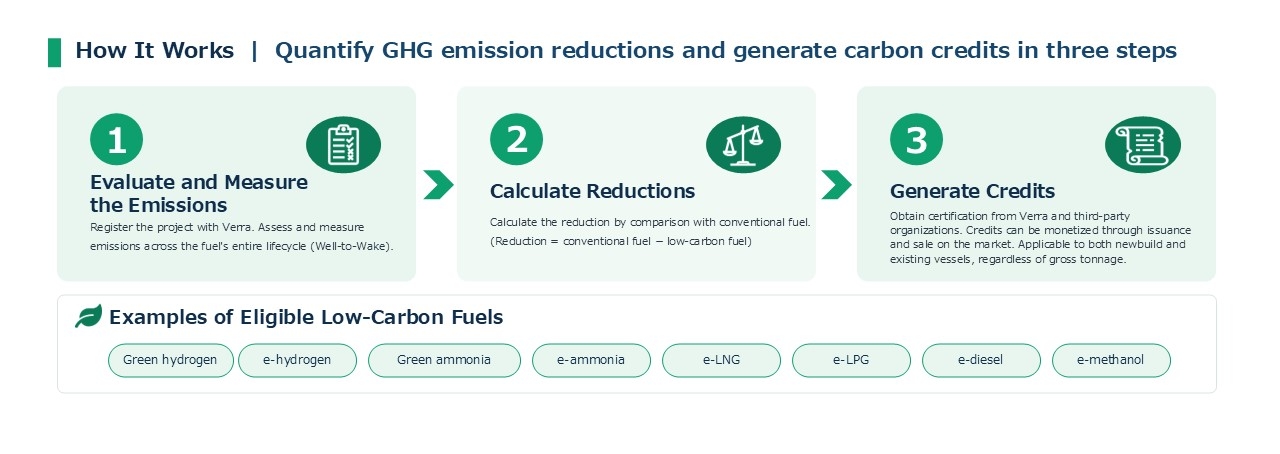
Through the development of this Methodology and other initiatives, IINO Lines will contribute to the scaling of the global carbon market. IINO Lines will also continue to strengthen collaboration with relevant organizations in Japan and overseas and promote initiatives toward the decarbonization of the shipping industry and the realization of a sustainable society.
Overview of the Methodology
This Methodology enables the generation of carbon credits by assessing emissions across the full fuel lifecycle (Well-to-Wake) and calculating emission reductions through comparison with conventional fuels.
In addition, the sale on the market of carbon credits generated under this Methodology is expected to create additional revenue opportunities, and IINO Lines believes that it will also contribute to improving the economic incentives for adopting low-carbon fuels.
Contribution to the Decarbonization of the Shipping Industry
The shipping industry is one of the sectors in which decarbonization is difficult, and this Methodology contributes to addressing that challenge in the following ways:
• Providing a highly accurate and internationally aligned method for calculating emission reductions
• Providing incentives for the introduction of low-carbon fuels, including the possibility of generating revenue through carbon credits
• Alignment with international decarbonization trends, including those of the International Maritime Organization (IMO)
Use of the Methodology
For individual projects that use the methodology approved by Verra, it will be possible to generate carbon credits by completing procedures such as registration with Verra and obtaining certification from third-party organizations. This Methodology is not limited to IINO Lines and can also be widely used by other shipping companies and transport operators. It is expected to contribute to the wider adoption of low-carbon fuels across the shipping industry and broader participation in the carbon market.
This Methodology applies to projects in which the following low-carbon fuels are used on vessels:
• Green hydrogen and e-hydrogen
• Green ammonia and e-ammonia
• Synthetic fuels such as e-LNG, e-LPG, e-diesel, and e-methanol
(Note)
Green fuels: An environmentally friendly clean energy produced using renewable energy that emits no CO₂ not only during use but also during production
e-fuels: An alternative fuel synthesized from hydrogen produced using renewable energy and captured CO₂ as feedstock. CO₂ emissions during combustion can be regarded as effectively zero.
*1 Details of "VM0053: Alternative Low-Carbon Fuels for Shipping, V1.0"
https://verra.org/methodologies/vm0053-alternative-low-carbon-fuels-for-shipping-v1-0/
*2 A nonprofit organization based in Washington, D.C., United States, established in 2007, and a leading provider of private-sector carbon credit certification
*3 A consulting company based in Switzerland and established in 1996. It primarily develops sustainable transport infrastructure in developing and emerging countries and evaluates GHG reduction projects
End