IINO President's 127th anniversary greetings
Yusuke Otani, President and Representative Director of IINO Kaiun Kaisha, Ltd. (IINO Lines) delivered its 127th anniversary greetings for July 1st, 2026 to all executives and employees of the IINO Group on June 30, 2026.
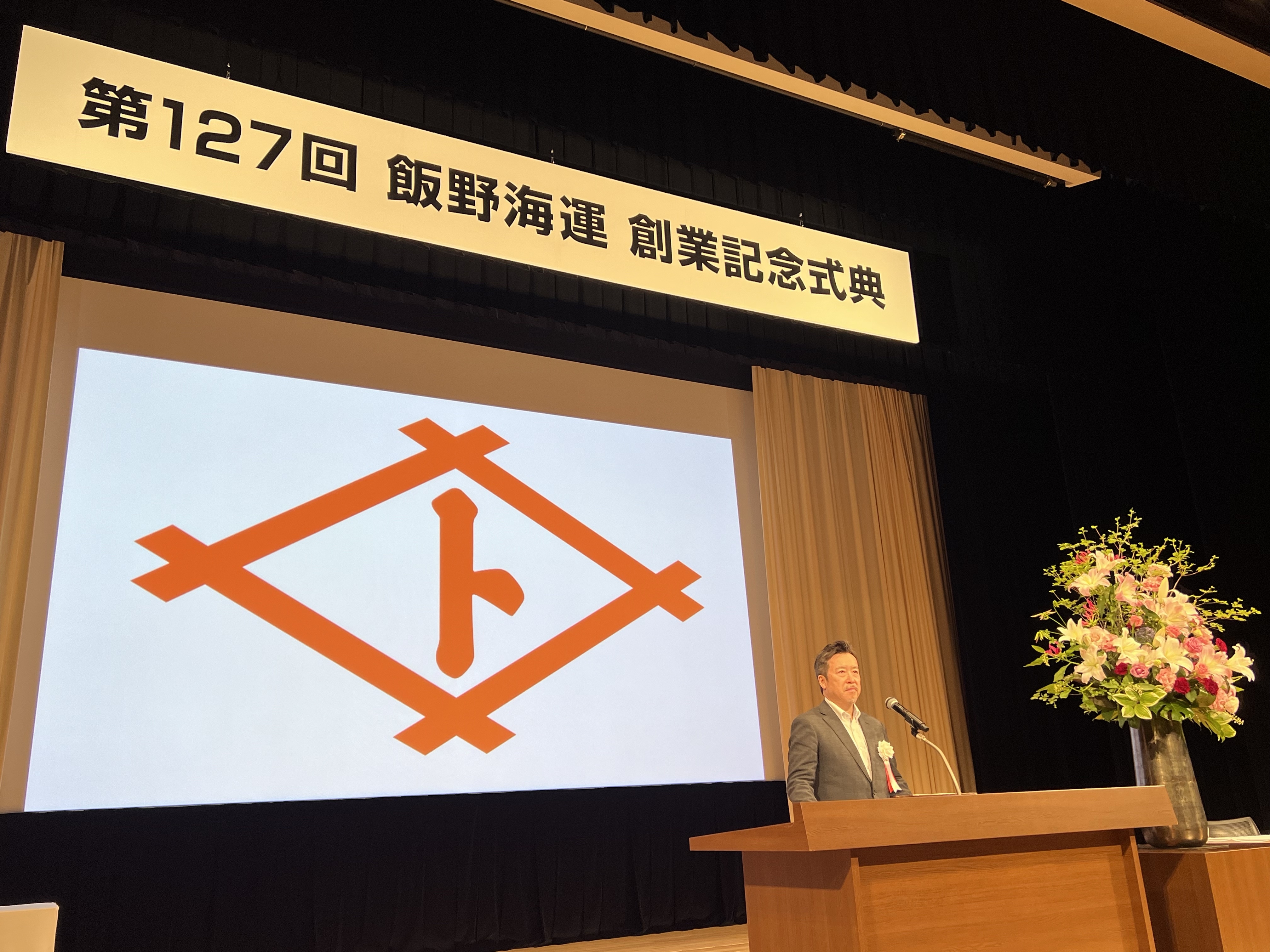
As we approach our 127th anniversary tomorrow, July 1st, I would like to extend IINO Lines' 127th anniversary greetings to all of our executives and employees.
First, I would like to express my sincere gratitude to all executives and employees who support our shipping business, real estate business, and the businesses of our Group companies through their daily efforts, as well as to all crew members who are working to ensure safe vessel operations at sea. In particular, I would like to express my deepest respect and appreciation to the seafarers who are engaged in operations under difficult conditions and to their families. We sincerely hope that free and safe passage through the Strait of Hormuz will be restored soon.
This year, I would like to take a slightly different perspective from previous years and look back on the history of IINO Lines and share how the Company has faced changes in its operating environment, what decisions it has made along the way, how it has reached its present form, and how IINO Lines' DNA has been passed down.
The Company's history began in July 1899, or Meiji 32, when our founder, Torakichi Iino, established IINO Shokai in Maizuru City, Kyoto Prefecture. Its initial business was coal transportation by tugboat and port cargo handling. Shortly after its founding, IINO Shokai expanded its business to coal delivery, cargo handling within ports, supply of workers, and transportation by barge and tugboat.
In 1918, IINO Shokai was reorganized as IINO Shoji Kaisha, Ltd. It was established with capital of 1 million yen, becoming a joint-stock company from an individually owned business.
In 1922, IINO Kisen Kaisha, Ltd. was established to separate and take over the marine transportation business that had been handled by IINO Shoji Kaisha, Ltd. This marked a clear step from port transportation into full-scale shipping operations.
An important part of the Company's development was its expansion into cargo ships and tankers. As the primary source of energy shifted from coal to oil, the Company entered the new field of tankers. In 1944, the Company changed its name to its current name, IINO Kaiun Kaisha, Ltd.
As wartime controls intensified, the Company developed its structure as a shipping company while entering an extremely difficult period. World War II inflicted enormous damage on the Company. The Company lost 40 vessels during the war, equivalent to 75% of its controlled tonnage. In addition, 790 seafarers lost their lives in the line of duty during the war, and including other employees who perishedin the line of duty, 813 precious lives were lost. This is a fact that must never be forgotten when speaking of the Company's history.
After the end of the war, the Company resumed operations with 13 vessels. In 1946, its head office was relocated from Maizuru City to Marunouchi, Chiyoda-ku, Tokyo. This was a major step for the Company as it made a new start during Japan's postwar reconstruction.
In 1949, the Company was listed on the Tokyo Stock Exchange. Amid the turmoil of the postwar period, the Company rose again as a shipping company and took on a role in supporting the recovery and growth of the Japanese economy.
Meanwhile, in the 1950s, there was an event that would become another major pillar for the Company in the future. This was the acquisition of Chiyoda Land and Building Co., Ltd. in 1955. This decision later led to construction of the IINO Building in 1960. In the same year, Chiyoda Land and Building Co., Ltd. was renamed IINO Fudosan Kaisha Ltd. The company made a substantial contribution to the reconstruction of the Company that followed the consolidation of Japan's shipping industry. The original form of the Company's business structure, combining shipping and real estate, was shaped during this period.
From the late 1950s through the early 1960s, the shipping market surrounding the Company fluctuated significantly. The closure of the Suez Canal caused tanker freight rates to surge temporarily, but the market subsequently faced a reactionary downturn. A fleet expanded during the boom, excessive investment, and deteriorating freight market conditions all followed. During this period, the Company came to deeply experience the severity of shipping as a market-driven industry.
A major turning point in this context was the consolidation of Japan's shipping industry in 1964. In this process, the Company separated its liner service division and transferred it to IINO Kisen Kaisha, Ltd. ,which subsequently merged with Kawasaki Kisen Kaisha, Ltd., and from that point onward, the Company's main focus became tanker and tramp cargo vessel operations. This was an extremely weighty management decision, made with the survival and reconstruction of the Company at stake. Relinquishing the liner service business must have involved great pain for the Company at the time. However, I believe that the determination not to accept a full merger with another company, and the perseverance to preserve the IINO Lines name, represent a fundamental spirit that has enabled the Company to continue to this day.
After the shipping industry's consolidation, the Company moved forward with its reconstruction. In 1971, it resumed dividend payments for the first time in 13 years. After a difficult period of reconstruction, regaining earnings power and being able to resume dividends to shareholders must have been a major milestone for the executives and employees of that time.
In 1972, the first-generation VLCC "TOHO MARU (Oil Tanker)" was completed, and the oil tanker business developed into one of the Company's core businesses.
In 1979, the chemical tanker "ESPOIR" was completed, and the IINO Group began chartering its first chemical tanker. In 1985, the Company began contract of affreightment with SABIC for the transportation of petrochemical products from the Middle East to the Far East. The chemical tanker business is not simply a business that follows market trends. It is built on a combination of knowledge of specialized cargoes, operational quality, sales capabilities, and long-term relationships of trust with customers. Here, too, we can see the accumulation of expertise and trust that is characteristic of the Company and has been passed down to the present.
The Company also expanded its gas transportation business in stages. In 1960, the "TOHO MARU (Gas Carrier)", Japan's first pressurized coastal gas carrier, was completed, and the Company entered the coastal LPG transportation business. In 1963, the "TOYOSU MARU ", the IINO Group's first oceangoing LPG carrier, was completed. Thereafter, the scope of gas transportation expanded significantly to include ethylene, VLGCs, LNG, and, in recent years, VLGCs equipped with LPG and ethane dual-fuel main engines.
In the dry bulk business as well, beginning with the "ZENKOREN MARU NO.5" in 1970, the Company expanded into various cargoes, including thermal coal, raw materials for fertilizers and feed, and wood chips. In 2000, the IINO Group's first capesize dry bulk carrier, "BLUE ISLAND", was completed.
The Company's current shipping business portfolio--oil, chemical, gas, and dry bulk transportation--has been built over many years by aligning our strengths with the evolving demands of each era.
In 1974, IINO Marine Service Co., Ltd. was established, creating a structure dedicated to ship management operations. In the following year, the Company established Japan's first system in which Japanese and foreign crew members worked together on board. This was an extremely innovative initiative in the industry, going beyond simply owning and operating vessels to enhancing ship management, crew assignment, and operational quality itself.
The real estate business also has an important history alongside the shipping business. In 1983, the Tokyo Fujimi Building was completed, followed by the IINO Takehaya Building in 1988. In 1997, IINO Fudosan Kaisha Ltd., then a subsidiary, was absorbed and merged into the Company, making clearer structure under which the Company operates shipping and real estate businesses in an integrated manner. As a function to support operation of the real estate business, IINO Building Maintenance Co., Ltd., the predecessor of IINO Building Technology Co., Ltd., was established in 1987. Having operational functions within the Group, such as maintaining safety and comfort, was important in improving the quality of the real estate business. Today's IINO Building Technology Co., Ltd. is an affiliated company that has developed within this flow.
The 1980s and 1990s were also difficult years for the shipping industry. Following the Plaza Accord in 1985, the Company faced many challenges, including the appreciation of the yen and a prolonged slump in the shipping market. During this period, the Company launched the 21st Century Committee and advanced emergency employment measures and the study of new businesses as cost structure reforms in response to declining earnings. This was also an initiative to identify new earnings opportunities as a Group in a difficult environment. Within this flow, various new businesses emerged, including convenience store and sports-related businesses. Among them, IINO Mediapro Co., Ltd., which operates a media-related business, was established as a company that would lead to one of today's affiliated companies.
In the 2000s, the Company further strengthened its overseas business. In 2002, it established IINO SINGAPORE PTE LTD. in Singapore, and in 2004, it established IINO UK LTD. in London. In 2006, the Company transferred chemical tanker operations to IINO SINGAPORE PTE LTD. and began preparations for future diversification of its workforce.
In the real estate business, the Shiodome Shibarikyu Building was completed in 2006. In 2011, the current IINO Building opened. The new IINO Building has taken on a new role as the Company's head office and as an urban space open to society.
Since then, the Company has continued to expand overseas and broaden its business portfolio, including by establishing local subsidiaries in the United States and Dubai and acquiring real estate properties in the United Kingdom.
Looking back in this way, I believe IINO Lines' history can be described as a history of reassessing its own position each time the environment changed and deciding what to preserve and what to change.
The Company's corporate philosophy and IINO VISION are extensions of this history. The philosophy of always giving top priority to ensuring safety, connecting people's wishes, and building a more abundant future is the very purpose of the Company's existence, which has continued in changing forms since its founding. The Company's businesses--transporting coal, crude oil, gas, chemical products, timber, and wood chips, while also providing places where people work in cities--have always supported people's lives and industries.
The official English corporate philosophy uses the wording "Connecting Wishes. Building a Brighter Future. Always Safety First."
By combining the shipping and real estate businesses, the Company has increased its resilience to changes in the environment and accumulated the strength to pursue the next growth investments. The business portfolio management now being advanced is an initiative to evolve this historical accumulation more strategically.
Under the new medium-term management plan, "Transformation for a Sustainable Future," covering the period from April 2026 to March 2031, the Company has adopted "transformation" as its theme, seeking to achieve both capital efficiency and growth investment for the realization of a sustainable future. What is important here is that this plan does not belong only to management. Each department and each Group company must recognize its own role and carry out its work as a mission. Only when the plan is connected to the work of each department, each Group company, and each individual will become a source of strength for the Company.
The Company has faced major changes many times before and has overcome them each time. Even so, the accumulation of thinking thoroughly and taking action, in order to remain a company in the next era, is what has made the IINO Group what it is today.
I believe the same will be required for the IINO Group going forward. We must place safety first, maintain quality, and continue to build trust with customers. On that basis, we must not regard changes in the times as someone else's concern, but consider them in connection with our own work and our own future. And we must take steps toward transformation. I would like all of you to be conscious that your own work, is part of this 127-year history and, at the same time, a step toward creating the history that lies ahead.
In closing, I would like to express my wishes for the safe operation of all the Group's vessels, the safe and accident-free operation of our buildings, the further prosperity of all IINO Group, and the good health and happiness of all the executives and employees of the Group and their families.
Thank you very much for your attention.
End