Policy
Basic Views
The Company's basic approach to establish relationship of trust with each stakeholders, which is the sustainable growth and enhancement of corporate value over the medium to long term, is expressed in the group-wide Corporate Philosophy, which states "Connecting Wishes. Building a Brighter Future. Always Safety First." In addition to the Management Policy and Code of Conducts to realize the Corporate Philosophy, the Group has established the Sustainability Policy composed of nine categories: Safety is Priority No. 1; Respect for Human Rights; Environmental Protection; Contribute to Society; Ensuring Thorough Compliance; Respects for Customers; Promotion of Diversity; Disclosure of Information and Communication; Education and Training. By putting the each policies into practice, we are working on corporate activities to solve environmental and social issues.
Therefore, we believe it is important to ensure the soundness, transparency and efficiency of management required to put the Sustainability Policy into practice through corporate governance, and we consider corporate governance to be a mechanism framework for coordinating the interest of the various stakeholders that comprise a company and for realizing efficient corporate activities.
Based on these views and under the Auditor System, we are working to both enrich our corporate governance and secure soundness, transparency, and efficiency in management, and concerning decision-making and operational execution in management, we are considerate of relationships with shareholders, employees, and other stakeholders, sparing no effort to produce the best corporate results, ultimately in an effort to create sustainable growth and enriching corporate value over the medium to long term.
Basic Policies
- While providing appropriate response to effectively secure the rights of shareholders and maintain an environment where shareholders can appropriately exercise their rights, we will be considerate in effectively securing fairness for all shareholders.
- We will be considerate of the rights and standpoints of various stakeholders, including shareholders, employees, customers, transaction partners, creditors, and regional societies, and work for appropriate cooperation with stakeholders.
- We will actively work toward appropriate disclosure of not only financial information, but also non-financial information, and aim to provide easy to understand and useful information disclosure alongside securing transparency.
- The Board of Directors, in view of the responsibility entrusted to it by shareholders and in an effort to create sustainable growth and enhance corporate value over the medium to long term, will appropriately fulfill its duties and responsibilities, including maintaining an environment to support appropriate risk taking and having highly effective supervision of directors. Auditors and the Board of Auditors, in view of the responsibility entrusted to them by shareholders, will appropriately fulfill their duties and responsibilities from an independent and objective standpoint, including auditing the execution of duties by directors.
- To contribute to sustainable growth and enhancement of corporate value over the medium to long term, we will engage in constructive dialogue with shareholders.
Structure
Organizational Structure
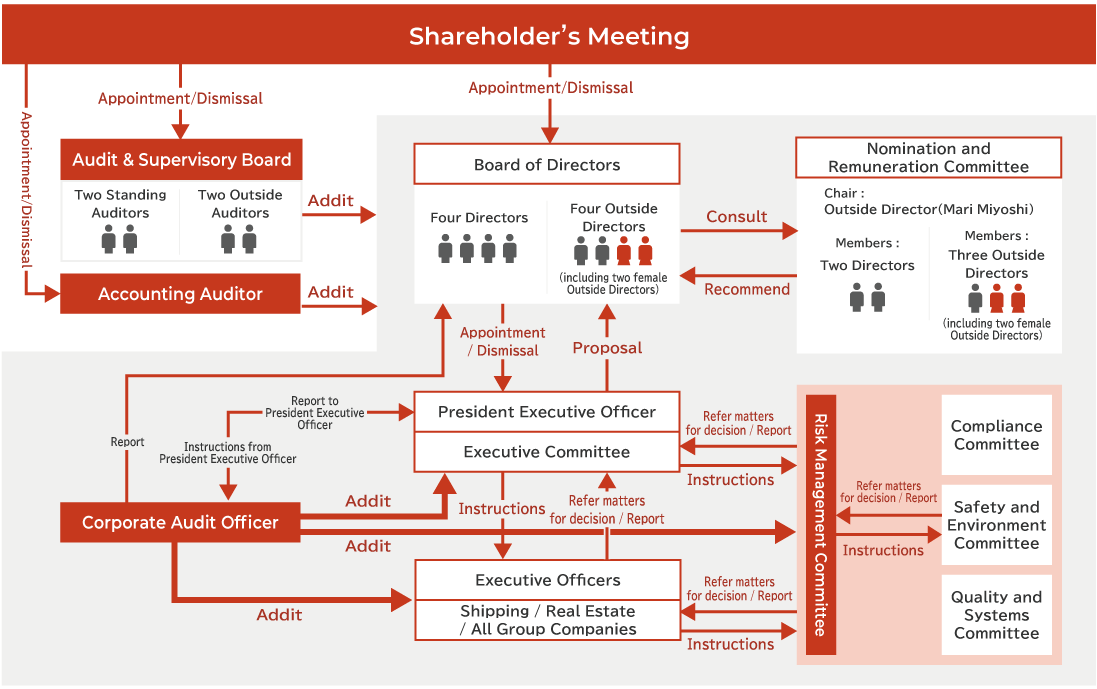
Organizational Structure (As of June 26, 2025)
Board of Directors / Executive Committee
The Board of Directors holds regular meetings once a month to decide important matters and supervise the directors' execution of duties and Executive Officers' business execution. Furthermore, the Executive Committee, which consists of the Executive Officers, holds regular weekly meetings to decide matters as requested by the Board of Directors, deliberate on matters as instructed by the Board of Directors, and exchange opinions concerning management.
Composition of the Board of Directors
The Board of Directors, in view of the responsibility entrusted to it by shareholders and in an effort to create sustainable growth and enhance corporate value over the medium to long term, will appropriately fulfill its duties and responsibilities, including maintaining an environment to support appropriate risk taking and having highly effective supervision of directors. To this end, in adequate consideration of balanced knowledge, experience, and ability alongside diversity in the overall Board of Directors, the Company's Board of Directors consists of eight directors (including four outside directors, two of whom are women).
At the General Meeting of Shareholders held in June 2022, the Articles of Incorporation were amended to clarify the management responsibilities of Directors and to set the term of appointment for Directors to one year, in order to develop a management system that can swiftly respond to changes in the management environment.
Directors are appointed from those who are of outstanding character, are knowledgeable, capable, and possess abundant experience, and are able to appropriately fulfill their duties with foresight.
Furthermore, outside directors are appointed from those who satisfy the requirements for outside directors set forth in the Companies Act who have constructive opinions and can be expected to contribute to the further growth of the Company. They are also personnel with high levels of professional expertise, such as persons with experience in diplomacy, or serving as corporate officers of other companies.
Annual Securities Report P47: Directors and Executive Officers (*Available only in Japanese)
Composition of the Board of Auditors
The Board of Auditors, in view of the responsibility entrusted to it by shareholders, will appropriately fulfill its duties and responsibilities from an independent and objective standpoint, including auditing the execution of duties by directors. To this end, in consideration of including persons with appropriate knowledge of finance and accounting, the Company's Board of Auditors consists of four auditors (including two outside auditors).
Auditors are appointed from those who are of outstanding character, are knowledgeable, capable, and possess abundant experience, and are able to appropriately fulfill their duties with the high level of professional expertise.
Furthermore, outside auditors are appointed from those who satisfy the requirements for outside auditors set forth in the Companies Act who are of outstanding character, are knowledgeable, capable, and possess abundant experience, and are able to appropriately fulfill their duties.
Refer to our Annual Securities Report for more information about the status of auditing and accounting.
Data List (Composition of the Audit & Supervisory Board)
Annual Securities Report P53: Status of Audits (*Available only in Japanese)
Board of Directors Skill Matrix (as of June 25, 2026) and Attendance at Board of Directors and Board of Auditors Meetings
In promoting priority strategies and business foundation strategy under the mid-term management plan, the Nomination and Remuneration Committee deliberated over the skills (knowledge, experience, abilities) to be possessed by the Board of Directors and selected the following eight skills.
| Position | Name | Expertise, Experience, and Skills | Attendance at Board of Directors Meetings (FY2024) |
Attendance at Audit & Supervisory Board Meetings (FY2024) |
|||||||||
|---|---|---|---|---|---|---|---|---|---|---|---|---|---|
| Year of Appointment as a Director or Auditor |
Corporate Management |
Business Strategy / Marketing |
Finance / Accounting |
Capital markets / IR |
Legal Affairs / Risk Management |
Human Resources / Labor Affairs |
ESG | Global Strategy | |||||
| Directors | Yusuke Otani |
2020 | ✓ | ✓ | ✓ | ✓ | ✓ | ✓ | 100% (21/21) |
− | |||
| Yuji Yasuki |
2024 | ✓ | ✓ | ✓ | ✓ | ✓ | ✓ | 100% (21/21) |
− | ||||
| Seiichi Fujimura |
2024 | ✓ | ✓ | ✓ | ✓ | 100% (21/22) |
− | ||||||
| Osamu Fushida |
2023 | ✓ | ✓ | ✓ | ✓ | ✓ | 100% (21/21) |
− | |||||
| Outside / Independent |
Mari Miyoshi |
2021 | ✓ | ✓ | 100% (21/21) |
− | |||||||
| Outside / Independent |
Tomonori Nonomura |
2023 | ✓ | ✓ | 100% (21/21) |
− | |||||||
| Outside / Independent |
Shizuyo Takahashi |
2023 | ✓ | ✓ | ✓ | 100% (21/21) |
− | ||||||
| Outside / Independent |
Takeshi Himeno |
2024 | ✓ | ✓ | 100% (21/21) |
− | |||||||
| Auditors | Yoshinori Hashimura |
2016 | ✓ | ✓ | ✓ | 100% (21/21) |
100% (10/10回) |
||||||
| Norikazu Shimizu |
2025 | ✓ | 100% (21/21) |
100% (10/10回) |
|||||||||
| Outside / Independent |
Kenkichi Fukuda |
2024 | ✓ | ✓ | 100% (21/21) |
100% (10/10回) |
|||||||
| Outside / Independent |
Yudai Miyake |
2024 | ✓ | ✓ | 100% (21/21) |
100% (10/10回) |
|||||||
Reasons for Skill Selection and Definitions
| Corporate Management | To create corporate value over the medium to long term, realize the Company's corporate philosophy, and ensure its sustainable growth, officers who possess corporate management experience and who can provide high-level decision making and advice on all aspects of business operations are required. |
|---|---|
| Business Strategy / Marketing |
It will be necessary to have officers with the experience and expertise needed to develop sales strategies and promote marketing initiatives in light of the specific characteristics of each business and market environment, in the Company's respective businesses, including its core shipping and real estate businesses. |
| Finance / Accounting |
The Medium-Term Management Plan sets forth a financial capital strategy as a key strategic priority, and to ensure the proper execution of fundraising, the formulation of capital strategy policy, and disciplined financial management, it is essential to have officers with knowledge and experience in finance and accounting. |
| Capital markets / IR |
The Company places a high priority on enhancing corporate value through constructive dialogue with capital markets. To achieve cost-conscious management and enhance corporate value, the Company requires officers with knowledge and experience in capital markets and investor relations. |
| Legal Affairs / Risk Management |
As the Company is expanding its business globally, it needs officers who have knowledge and experience of legal systems and various regulations in and outside Japan and are capable of appropriately assessing risks and leading prevention measures and countermeasures. |
| Human Resources / Labor Affairs |
To maximize corporate value by improving employee engagement through the implementation of human resource strategies, such as securing diverse human resources, officers equipped with knowledge and experience in personnel and labor affairs (or human resources development) are needed. |
| ESG | The Medium-Term Management Plan identifies decarbonization as a key strategic priority, and outlines a business foundation strategy that includes human capital management, ensuring safety through high-quality asset management, and strengthening an appropriate governance framework. Consequently, it will be essential to have officers equipped with knowledge and experience in these fields, including the adoption of new technologies. |
| Global strategy | As the Company expands its business globally, it requires officers with overseas work experience as well as knowledge and experience in overseas business practices in order to promote its business strategy, which is one of the priority strategies in the Medium-Term Management Plan. |
Nomination and Remuneration Committee
IINO LINES established the Nomination and Remuneration Committee in October 2019 as a voluntary advisory body serving the Board of Directors to enhance objectivity, transparency, and fairness of procedures concerning the nomination of candidates for Director, etc., and remuneration of Directors and strengthening the supervision and accountability of the Board of Directors to further enhance the corporate governance system. The Committee consists of five members, namely, three Outside Directors and two Directors, and is chaired by an Outside Director. At the request of the Board of Directors, the Committee deliberates on the following matters and provides recommendations to the Board of Directors. The Committee met 10 in FY2025.
Attendance at Nomination and Remuneration Committee Meetings (FY2025)
| Position | Name | Attendance |
|---|---|---|
| Directors | Yusuke Otani | 90% (9/10) |
| Directors | Osamu Fushida | 100% (10/10) |
| Directors Outside / Independent |
Mari Miyoshi | 100% (10/10) |
| Directors Outside / Independent |
Shizuyo Takahashi | 100% (10/10) |
| Directors Outside / Independent |
Takeshi Himeno | 100% (10/10) |
Data List (Composition of the Nomination and Remuneration Committee)
Executive Officer System
Since June 28, 2016, the Company has changed from an operational execution structure with Executive Directors to an Executive Officer system with Executive Officers, and by strengthening decision-making functions regarding important matters and supervisory functions for business execution of the Board of Directors, we are working to further enhance corporate governance.
Internal Control System
Under mutual cooperation between auditors, the Corporate Audit Office, and the accounting auditor, the Company seeks to strengthen internal controls.
To appropriately implement audits of the IINO Group, auditors monitor the independence of the accounting auditor while receiving explanations regarding the content of accounting audits from the accounting auditor, and through deep cooperation in the form of information exchange with the accounting auditor, raise the quality of their respective audits.
To strengthen corporate governance and internal controls, the Company established an Internal Audit Office in October 2005. In June 2019, the name of this office changed to the Corporate Audit Office.
Based on the Internal Audit Regulations, the Corporate Audit Office cooperates with the Company's auditors and the accounting auditor to conduct audits on business activities in all companies comprising the IINO Group to secure appropriate business execution across the entire Group.
Additionally, auditors and the Corporate Audit Office hold periodic meetings once a month in principle, while standing auditors exchange information with the Corporate Audit Office as required to raise the quality of their respective audits.
Initiatives
Independence of Outside Directors and Auditors
Concerning the independence and qualities required of outside directors and outside auditors, the Company has defined the "Criteria Relating to the Independence and Qualifications of Outside Directors and Auditors" below.
Criteria Relating to the Independence and Qualifications of Outside Directors and Auditors
These criteria are to determine the independence of candidates for outside director and outside auditor (hereinafter collectively referred to as "Outside Officers") of the Company and also set forth the qualities required of candidates.
Outside Directors
As candidates for outside director, the Company shall nominate persons who satisfy the requirements for outside directors set forth in the Companies Act; are of outstanding character; are knowledgeable, capable and possess abundant experience; are able to appropriately fulfill the duties of outside directors; hold constructive opinions; and are expected to contribute to further growth of the Company, and the Company shall give consideration to ensuring a balance of knowledge, experience, and abilities and the diversity of the Board of Directors as a whole.
Outside Auditors
As candidates for outside auditor, the Company shall nominate persons who satisfy the requirements for outside auditors set forth in the Companies Act; are of outstanding character; are knowledgeable, capable, and possess abundant experience; and are able to appropriately fulfill the duties of outside auditors, and the Company shall give consideration to ensuring that persons with appropriate knowledge of finance and accounting are included.
Criteria for Determining the Independence of Outside Officers
In the Company's judgment, a person to whom none of the following items applies satisfies the independence criteria for an Outside Officer or candidates for Outside Officer.
- A business executor of the Company or a subsidiary of the Company*1.
- A person for whom the Company is a major business partner*2 or a business executor thereof.
- A major business partner of the Company*3 or a business executor thereof.
- A current major shareholder of the Company (a person who directly or indirectly holds 10% or more of total voting rights) or a business executor thereof.
- A person who undertakes audits of the Company as the Company's accounting auditor or an employee etc. thereof.
- A consultant or accounting, legal, tax, or other professional receiving a significant amount*4 of money or other assets from the Company other than executive remuneration. When such a person is an organization such as a corporation or association, this includes a person belonging to such organization.
- A person who receives a significant amount*4 of donations or aid from the Company. When such a person is an organization such as a corporation or association, this includes a director or business executor thereof.
- When an executive officer or standing auditor of the Company concurrently serves as an outside director or outside auditor of another company, a person who is an executive director, operating officer, or executive officer of such other company.
- A person who fell under 1 to 8 above during the past three years*5.
- A person falling under 1 to 9 above or, in the case of determining the independence of an outside auditor, a spouse or relative within the second degree of kinship of an important person falling under any of the following items*6.
a. An accounting advisor of the Company (if such accounting advisor is a corporation, including an employee who executes the corporation's duties; the same below)
b. A director or accounting advisor who is not a business executor of a subsidiary of the Company
c. A person who fell under (a) or (b) above or who during the past three years has been a director who was not a business executor of the Company
*1 "Business executor" means an executive director, operating officer, executive officer, or other equivalent person or an employee.
*2 "Person for whom the Company is a major business partner" means a person receiving from the Company payments in an amount equivalent to at least 2% of annual consolidated sales in the business partner's most recent fiscal year.
*3 "Major business partner of the Company" means a person who has made payments to the Company in an amount equivalent to at least 2% of the Company's annual consolidated sales in the most recent fiscal year or who has made loans to the Company in an amount equivalent to at least 2% of the Company's consolidated net assets in the most recent fiscal year.
*4 "Significant amount" of money means financial assets received from the Company of 10 million yen or more per year if such person is an individual or if such person is an organization such as a corporation or association, an amount of 10 million yen or more per year that is equivalent to at least 2% of annual consolidated sales or total revenues in such organization's most recent fiscal year.
*5 With regard to 4. above, this means a person who was a business executor of a current major shareholder of the Company during the past three years.
*6 "Important person" includes a director (excluding an outside director), auditor (excluding an outside auditor), executive officer, employee in a management position of department manager or higher, certified public accountant belonging to an accounting auditor, and attorney belonging to a law firm (including an associate).
Effectiveness of the Board of Directors
Aiming to improve the functioning of the Board of Directors to achieve sustainable growth and enhance corporate value over the medium and long term, the Company has undertaken an analysis and review of the effectiveness of the Board of Directors, covering all directors and auditors.
Summary of FY2025 implementation
Questionnaire period: The survey was conducted from January 23 to February 6, 2026.
With the aim of enhancing the effectiveness of the Board of Directors, a self-evaluation questionnaire consisting of 43 questions was conducted in FY2025. The questionnaire focused primarily on:(i) the composition of the Board of Directors,
(ii) the operation of the Board of Directors,(iii) discussions at the Board meetings,(iv) the Board's monitoring function, and(v) the performance of outside directors. In addition to the five-point multiple-choice scale, each question included a written-response section to allow respondents to freely express their views and opinions.
Results of the Effectiveness Evaluation
The Company confirmed that its Board of Directors is operated with an appropriate structure and number of members, and that, with respect to the items evaluated through the questionnaire, the Board has been functioning appropriately overall, thereby ensuring the effectiveness of the Board of Directors. On the other hand, with a view to further deepening and enhancing discussions at meeting of the Board of Directors, some opinions were expressed calling for improvements, including reducing the number of agenda items and sharing summaries and key discussion points at an earlier stage.
Issues for FY2025
With regard to discussions on management strategies and management plans aimed at creating medium- to long-term corporate value, which were identified as key issues for the year, it was confirmed that such discussions have deepened, reflecting hightened awareness of capital costs and portfolio management. However, with respect to DX initiatives and human resource strategies, which remain ongoing challenges, some views were expressed indicating that there is still room for further improvement. On the other hand, the support provided by the Secretariat-such as conducting briefings to organize key discussion points in advance and devising a logical structure for reference materials-received a certain level of positive evaluation.
Issues to be addressed in FY2026
Amid increasing uncertainty in the business environment, it was recognized that further enhancement of the effectiveness of the Board of Directors is necessary in order to execute management strategies aimed at achieving the Company's desired future state. In this context, issues identified include strengthening the Board's oversight function, as well as further discussions regarding human capital and human resource strategies, and DX initiatives. Based on the new mid term management plan, the Company will seek to further enhance and deepen discussions at the Board of Directors on these issues from the perspective of improving medium- to long-term corporate value.